Formula 1 is synonymous with iconic tracks like Monza, Silverstone, and Spa-Francorchamps—but peppered throughout its history are several fascinating, now-forgotten circuits that hosted the world's fastest cars just once or a handful of times.
These lost venues each brought unique challenges, unforgettable moments, or simply curious stories that didn't quite fit into the modern mould of Formula.
Let's revisit some of the most memorable forgotten F1 circuits that briefly etched their names into Grand Prix history.
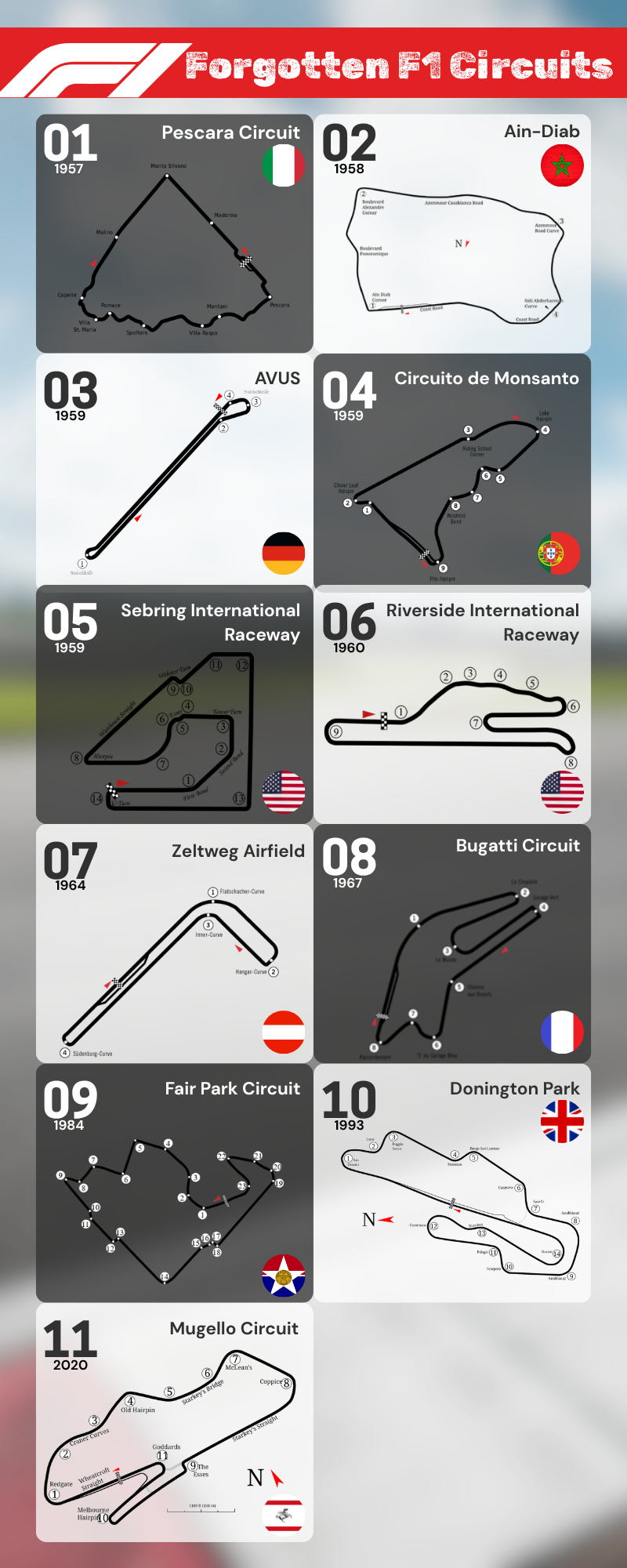
The longest circuit ever to host a Formula 1 Grand Prix, Pescara was a monstrous 25.8 km (16 miles) of public roads winding along the Adriatic coastline and into the hills of Abruzzo. Used for the 1957 Pescara GP, this one-off race was held during a time of calendar uncertainty and drew massive crowds. The sheer length and danger of the track, with its fast straights, narrow villages, and lack of run-off, meant it was never used again. Still, Stirling Moss' win here remains legendary.
Set on public roads near Casablanca, the Ain-Diab circuit hosted the final round of the 1958 championship. The race crowned Mike Hawthorn as Britain's first F1 World Champion, but was also tragically overshadowed by the death of Stuart Lewis-Evans. Safety concerns and political tensions meant the Moroccan GP never returned to the calendar.
Berlin's AVUS (Automobil-Verkehrs- und Übungsstraße) is perhaps the most unusual F1 circuit ever used. Essentially a two-lane motorway with a colossal banked curve at one end, it made for spectacular visuals—but terrifying racing. The 1959 German GP was the only time F1 ventured here, with Tony Brooks winning after surviving the ultra-fast, ultra-dangerous course. The steep banking, once hailed as a showcase of speed, was ultimately deemed far too risky.
Nestled in a public park in Lisbon, the Circuito de Monsanto was a mix of fast straights and winding woodland roads—picturesque, yes, but incredibly bumpy and inconsistent. The race was won by Stirling Moss, but the challenging surface and safety hazards meant F1 never came back. It remains a curiosity in the sport's early globe-trotting years.
Better known today for endurance racing, Sebring hosted the inaugural United States GP in 1959. Although the track was flat and full of character, it failed to attract much of a crowd. Ironically, the race itself was historic—Bruce McLaren won his first GP, becoming the youngest winner at the time. Despite the momentous occasion, F1 left Sebring behind for more commercially viable options.
F1 moved west for the 1960 US GP to Riverside, a swooping desert road course near Los Angeles. A fan favourite in American motorsport circles, Riverside offered flowing corners and elevation changes, but again failed to draw big F1 crowds. The event was a financial disappointment, and the championship returned to the East Coast the following year.
The original Austrian GP wasn't held at the Red Bull Ring (formerly A1-Ring), but on an old airfield in Zeltweg. The makeshift track was fast and flat, with little charm and even less grip due to its rough concrete surface. The race proved too hard on cars and drivers alike, and after one race—won by Lorenzo Bandini—F1 passed on Zeltweg until a permanent circuit was built nearby.
Located inside the famous 24 Hours of Le Mans circuit, the Bugatti Circuit hosted the 1967 French GP. While technically advanced and equipped with great facilities, it lacked the flair and challenge of the full Le Mans layout. Fans and drivers found it dull, and the experiment was never repeated. Jack Brabham took victory on the day, but the Bugatti Circuit didn't capture the hearts of the F1 world.
Held in sweltering July heat, the Dallas GP around Fair Park was a bold effort to grow F1 in America's heartland. But the extreme temperatures caused the track to break up, cars to overheat, and tempers to flare. Despite Keke Rosberg taking a gritty win, the event was a logistical mess, and the one-and-done Dallas GP became infamous. It did, however, deliver Nigel Mansell collapsing while trying to push his car over the finish line—an enduring image in F1 folklore.
The only F1 race ever held at Donington Park is remembered for one reason: Ayrton Senna's masterclass in the wet. His first lap is considered one of the greatest in motorsport history, passing four cars in changeable conditions. Despite the success, the circuit's facilities were deemed inadequate for long-term F1 use, and the series returned to Silverstone for good.
When the COVID-19 pandemic reshaped the F1 calendar in 2020, Mugello—a Ferrari-owned test track in Tuscany—stepped in. The Tuscan GP delivered high drama: a multi-car pile-up, multiple red flags, and a well-earned win for Lewis Hamilton in front of limited fans. Its flowing corners and high-speed challenges were a hit with drivers, but Mugello returned to its test-track roots after this one-time feature.