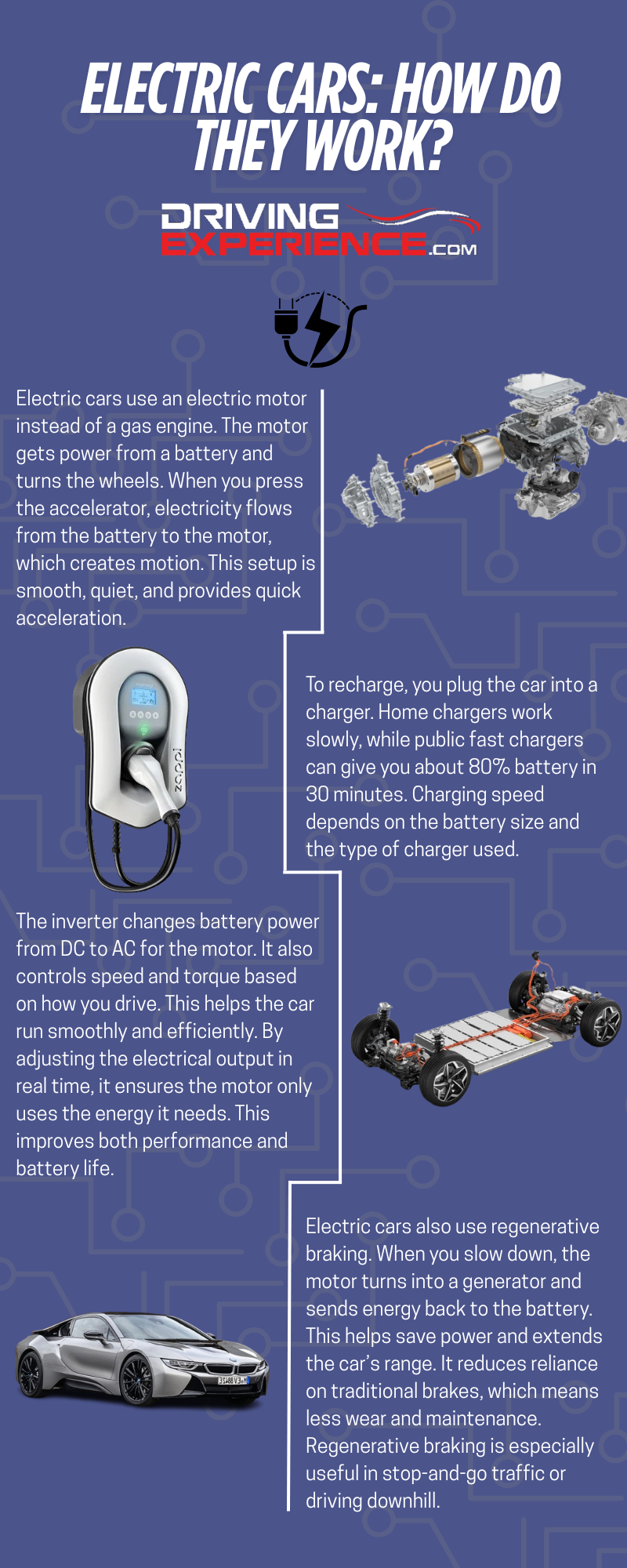
This guide explains how electric cars work, covering the battery, motor, inverter, and regenerative braking. An infographic is included to make it easier to understand the key parts and how they power the vehicle efficiently.
Electric cars are powered by an electric motor, which works differently from the internal combustion engine in traditional gasoline vehicles. Instead of using fuel to create combustion, the motor in an electric vehicle (EV) relies on electricity stored in a battery. When the driver presses the accelerator, the motor uses energy from the battery to create rotational force (torque) that drives the wheels. Electric motors are highly efficient and deliver instant torque, meaning they can accelerate much faster than conventional cars. The powertrain in an electric car typically includes a motor, an inverter (which converts DC power from the battery into AC power to run the motor), and a transmission that directs the motor’s power to the wheels.
Recharging an electric car involves replenishing the battery with electrical energy, and this can be done in a few different ways. Most commonly, EVs are charged using a standard home charging station that plugs into a wall outlet. For faster charging, many owners use a Level 2 charging station, which can fully charge a battery in several hours. Public fast-charging stations also exist, which can charge an EV to about 80% in 30 minutes or so. The charging process depends on the battery’s capacity and the type of charger, with the key limitation being the availability of charging infrastructure.
The inverter plays a key role in the functioning of an electric car by converting the electricity stored in the battery into a usable form for the motor. While the battery provides direct current (DC), most electric motors operate on alternating current (AC). The inverter switches the DC to AC and also adjusts the frequency and voltage depending on how much power the driver demands. It works closely with the motor controller to regulate speed and torque. This allows the car to respond smoothly to acceleration or braking and helps optimize energy use for efficiency and performance.
In addition to recharging, another key feature of electric cars is regenerative braking. This system allows the vehicle to recover energy that would otherwise be lost during braking. When the driver slows down or applies the brakes, the electric motor switches roles and acts as a generator. It converts the kinetic energy of the car back into electricity, which is sent back to the battery. This not only helps to extend the driving range of the car but also reduces wear and tear on traditional brake components, making EVs more cost-effective over time.
Our Electric Car Driving Experiences give you the chance to get behind the wheel and feel the unique performance of an EV for yourself. From smooth acceleration to silent cruising, you’ll discover how electric power changes the way a car drives. Whether you're curious about the technology or considering making the switch, our hands-on sessions let you experience the instant torque, regenerative braking, and overall comfort that define electric vehicles. It's the perfect way to understand what makes EVs different - by driving one.